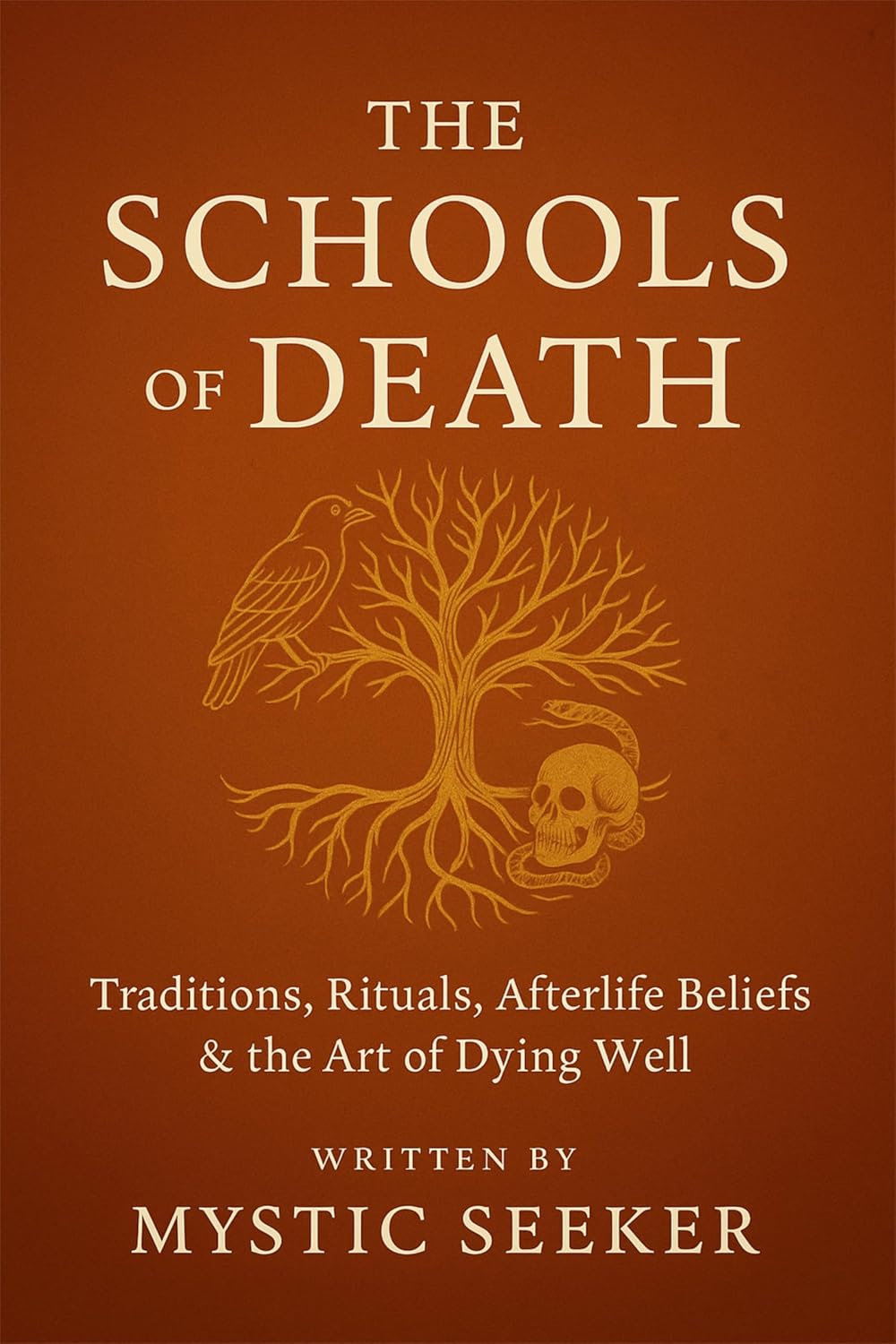
Book study guide
The Schools of Death Study Guide
Traditions, Rituals, Afterlife Beliefs & the Art of Dying Well
The Schools of Death study guide: From reincarnation and impermanence to ancestor traditions and philosophical reflection, this book explores how civilizations have learned from death. Explore key ideas, reader fit,...
Orientation
What this book is really about
From reincarnation and impermanence to ancestor traditions and philosophical reflection, this book explores how civilizations have learned from death.
Readers interested in death across traditions.
Seekers looking for a wider frame than one lineage alone can offer.
Anyone curious about mortality as a human and spiritual theme.
Idea map
The main movements of the book
Movement 1
How different traditions understand the meaning of death and dying.
The Schools of Death surveys the rituals, ideas, and afterlife visions that different cultures used to frame mortality. It is not a catalogue of curiosities but a meditation on the human effort to face the unknown with dignity.
Movement 2
What rituals and beliefs reveal about a culture's deepest values.
As the book moves across traditions, it keeps returning to a deeper question: what does a vision of death teach about how one should live? That gives the book both comparative reach and personal relevance.
Reading plan
A focused way to read it
Before reading
Read the synopsis and choose one question you actually care about. For The Schools of Death, a good starting question is: How can loss, impermanence, and death be met without denial, panic, or emotional numbness?
First pass
Move through the book for orientation. Mark the ideas that feel useful, uncomfortable, or unusually clear. Do not try to settle every question immediately.
Second pass
Return to the sections connected with afterlife beliefs, ritual, impermanence. Translate each idea into one observation about your life, practice, or understanding.
After finishing
Continue into the Letting Go & Impermanence reading path or one of the related Study Hubs so the book becomes part of a larger inquiry.
Key concepts
Terms and ideas to keep nearby
afterlife beliefs
afterlife beliefs gives language to a difficult part of loss, care, or impermanence without forcing the experience into easy answers.
ritual
The book returns to ritual when grief needs steadiness, tenderness, and practical honesty rather than abstraction.
impermanence
impermanence helps the reader stay close to what hurts while still finding a usable way forward.
meaning
meaning gives language to a difficult part of loss, care, or impermanence without forcing the experience into easy answers.
cross-cultural wisdom
The book returns to cross-cultural wisdom when grief needs steadiness, tenderness, and practical honesty rather than abstraction.
death traditions
death traditions helps the reader stay close to what hurts while still finding a usable way forward.
afterlife
afterlife gives language to a difficult part of loss, care, or impermanence without forcing the experience into easy answers.
rituals
The book returns to rituals when grief needs steadiness, tenderness, and practical honesty rather than abstraction.
comparative religion
comparative religion helps the reader stay close to what hurts while still finding a usable way forward.
mortality
mortality gives language to a difficult part of loss, care, or impermanence without forcing the experience into easy answers.
Practice
Turn the reading into reflection
How different traditions understand the meaning of death and dying
Use this gently. Choose one moment where the idea can make grief, caregiving, or uncertainty a little less lonely and a little more honest.
What rituals and beliefs reveal about a culture's deepest values
Bring this into a real conversation, memory, or decision. The aim is not to solve grief, but to meet it with more steadiness.
How cross-cultural reflection can soften fear and expand perspective
Keep the practice small enough to be human: one breath before reacting, one honest sentence, one act of care that does not abandon yourself.
Where does "afterlife beliefs" show up in your daily choices, relationships, or inner speech?
What would become simpler if you took "ritual" seriously for one week?
Which habit, fear, or assumption does "impermanence" ask you to examine rather than defend?
How would your next decision change if "meaning" became the lens for reading this book?
Where does "cross-cultural wisdom" show up in your daily choices, relationships, or inner speech?
What would become simpler if you took "death traditions" seriously for one week?
Which habit, fear, or assumption does "afterlife" ask you to examine rather than defend?
How would your next decision change if "rituals" became the lens for reading this book?
Reader questions
Questions this guide helps answer
What is the best way to read The Schools of Death?
Read The Schools of Death slowly enough to connect each idea with one real situation. The most useful approach is to move between the book's explanation, your own reflection, and one practical change in attention or behavior.
What questions does The Schools of Death help with?
The Schools of Death is especially useful for questions around afterlife beliefs, ritual, impermanence, meaning, cross-cultural wisdom. It is written to make the material readable without stripping away its depth.
Is The Schools of Death beginner friendly?
The Schools of Death can be read by serious beginners, but it works best when the reader is willing to slow down and reflect rather than skim for quick conclusions.
What should I read after The Schools of Death?
Use the related books, Study Hubs, and reading paths on this page to continue into connected themes without losing the thread of the book.
Continue reading
Related books
Continue through connected ideas without losing the thread opened by this guide.
The Peaceful Death Handbook
A Practical Guide to Mortality, Caregiving, Grief & Letting Go
This book is not only about the final moment. It is about the whole human field around dying: fear, caregiving, unfinished relationships, preparation, grief, and the truths mortality brings close.

Understanding the Tao
Lao Tzu's Path to Effortless Wisdom
This book turns the Tao from a distant idea into a way of moving through work, grief, relationships, burnout, and daily pressure with more softness and steadiness.

The Bhagavad Gita Reimagined
Awaken Your Inner Guide
Instead of approaching the Gita as a remote scripture, this book treats it as a live conversation for moments of confusion, duty, fear, and inner conflict.

The Many Gitas
A Clear, Beginner-Friendly Guide to the Bhagavad Gita and the Other Great Gitas
Most readers know the Bhagavad Gita and never realize there is a wider library of Gitas. This book opens that larger world with structure, clarity, and context.